
For studio R&D teams, incubators and pitches
A real backend for your multiplayer prototype, today
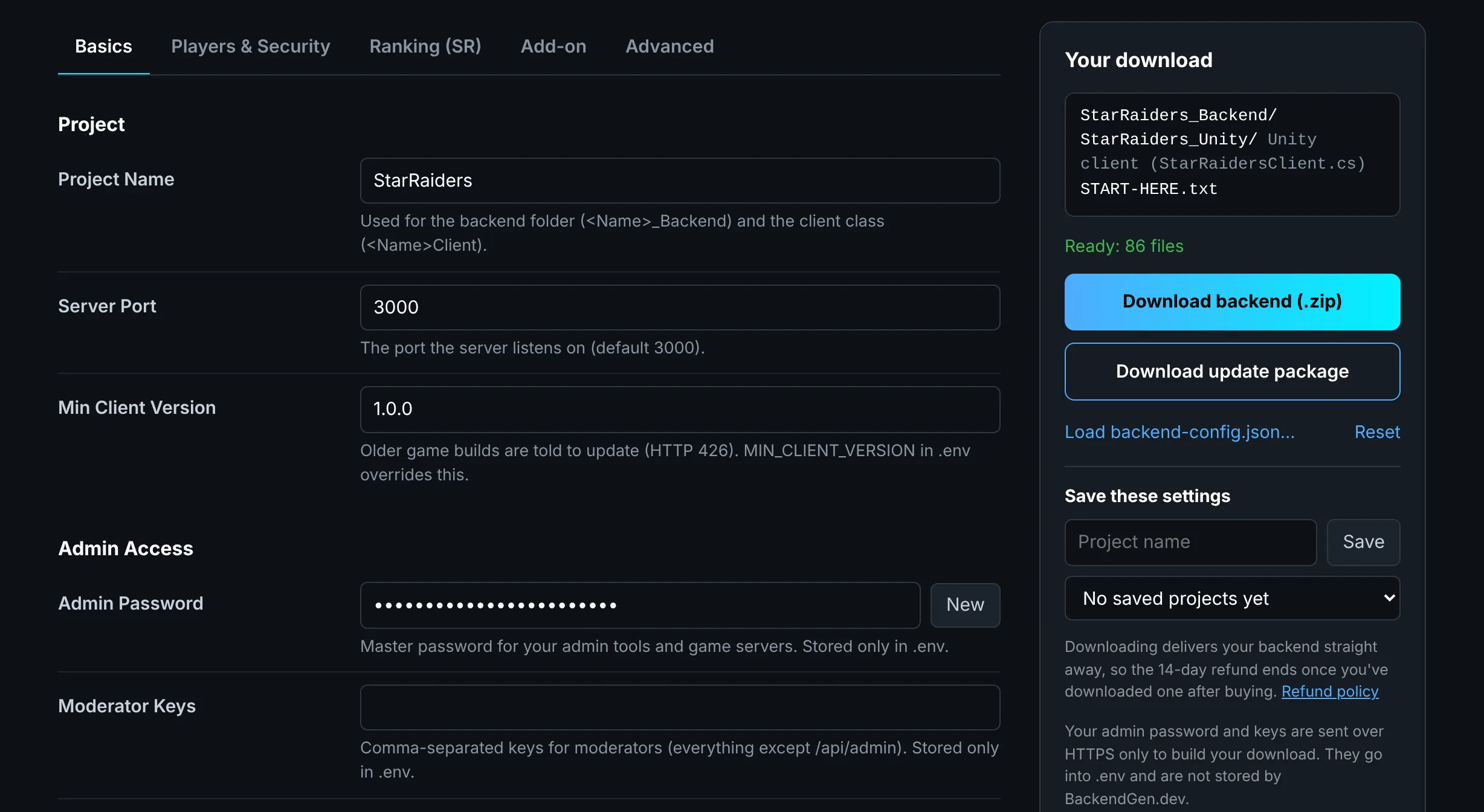
Find out if the loop is fun before anyone builds a server. BackendGen.dev generates a working backend for your Unity, Godot, Unreal or web prototype in minutes: real sign-in, saved player data and match rankings, plus matchmaking, lobbies and live rooms with Advanced. It runs on a laptop, and if the idea is greenlit, the same code goes to production.
- Running in minutesOn a laptop: no cloud account, no Docker.
- The real thing, not a mockYour gameplay team codes against the real API.
- Greenlit? Keep it.Same code on a server, scales with Advanced.
- Scrapped? Cheap.One licence, unlimited projects.
From idea to playtest to launch
Prototypes stall when the backend waits on IT, a cloud account or a sprint of its own. Here it doesn't.
- Generate and run it
Tick what the prototype needs and download. Double-click
start-localand the backend is up on your laptop, database included. Teammates on the same network can connect straight away. - Build the game against it
The Unity, Godot, Unreal and JavaScript clients come with the download, so the gameplay team signs players in, saves data and posts match results from day one. Your networking library still runs the gameplay.
- Playtest and decide
Put it on a small server with HTTPS when outside testers should play (the step-by-step guide takes about 20 minutes the first time). With Advanced, see who came back and change game values without a new build.
- Greenlit? Grow it.
Keep the same backend. With Advanced, choose PostgreSQL in the generator and run the included
migrate-sqlite-to-postgres.js: your playtest players and data come across, and the SQLite file stays as a backup. Then run several servers behind the included load balancer.
What a prototype usually needs
All of it is in the download as plain, commented Node.js. Switch on only what this prototype needs.
👤 Players
Base
- Sign-in with a gamertag, no email needed for testers
- Saved player data, with rules for who can read and change what
- Rename, data export and account deletion built in
🏆 Competition
Base
- Match results and skill rating (SR): 1v1, teams, or free-for-all up to 200 players
- Rank tiers and SR history
- Leaderboards with Advanced
🛠️ Looked after
Base
- A self-test and a load test in every download
- Automatic backups
- An OpenAPI description for any other engine or tool
🎮 Multiplayer Advanced
Around your netcode
- Matchmaking queues that keep parties together
- Lobbies, parties and live rooms over one real-time connection
- A game-server fleet with one-use join tickets
📊 Playtest data Advanced
Learn from every session
- Daily players, retention and your own events, with CSV export
- Remote config: change game values without a new build
- An admin dashboard to look up testers and moderate
💰 Economy Advanced
If the loop has rewards
- Currencies and items, checked on the server
- Coupons and probability tables (loot drops with published odds)
- Cloud saves and player mail
For studios and incubators
Many small bets, few of which ship. The backend shouldn't be the expensive part of each one.
What you can count on
- One licence covers unlimited projects, so every prototype after the first costs nothing extra.
- The whole team can use and change the generated code; studio licences give 5 or 10 seats for the people who run the generator.
- The code and the data stay with you: nothing phones home, no licence server, no telemetry.
- When a prototype is greenlit, it scales: on one rented 8-core server, the real-time test kept 50,000 players connected.
What it isn't
- Not netcode: gameplay still runs on your networking library or game servers.
- Not a hosted service: someone on the team runs the server once testers are outside the office.
- Not a game engine plugin for Unreal yet: there's a C++ guide instead.
Questions from R&D teams
Do we need a cloud account or a server to start?
No. The backend runs on a laptop: double-click start-local and it's up in minutes, with the SQLite database built in. Teammates on the same network can connect to it straight away. You only need a server when testers outside the office should play.
Does it work with our networking library?
Yes. Your networking library (Mirror, Fish-Net, Netcode for GameObjects or Godot's multiplayer) runs the gameplay; the backend runs sign-in, player data, rankings and, with Advanced, matchmaking, lobbies and the game-server fleet around it. There are step-by-step guides for each.
If the prototype is greenlit, do we have to rebuild the backend?
No. It's the same code you'd run in production: put it on a server with HTTPS using the included guides. When you outgrow one server, Advanced switches to PostgreSQL and several servers, and the included migration script copies your existing SQLite data across. Updates keep your own plugins, settings and data.
Can several people on the team use it?
Everyone can use and change the code the generator makes: it's yours. Each person who runs the generator needs their own licence; studio licences give you 5 or 10 Advanced seats for less, and you can move a seat when people change.
What if we scrap the idea?
Then it cost a licence, not weeks of backend work, and the licence carries on to your next prototype: one licence covers unlimited projects.
Try it on today's idea
Every setting works on a free account, so you can see exactly what you'd get. You only need a licence to download.